Pages

Wednesday, August 30, 2017

The Panchatantra - Story 69

STORY NO. 69. KANDARPAKETU KICKED BACK TO EARTH 


Kandarpaketu was the handsome son of Jimutavahana, king of Simhaladwipa(Ceylon) and
was in the prime of youth. A merchant told him in his pleasure ground one day, that on every Chaturdasi(The Fourteenth day of the lunar fortnight, the day before the new moon or full moon) day a maiden, beautiful like Lakshmi and bedecked with wonderful ornaments could be seen seated on a costly couch in the midst of the great sea under a Kalpavriksha tree(The mythical wish-fulfillment tree). Kandarpaketu's curiosity was roused. He went to the spot indicated, at the time indicated, and saw the dazzling beauty seated under the Kalpa tree as described. On seeing him, she disappeared into the sea. Smitten with love, he jumped after her from the Kalpavrikisha. He went down and down and saw a golden city below the waters. 

The beautiful maiden was sitting on a golden couch surrounded by young and pretty vidyadhans(Celestial songstresses) in a golden palace there. On seeing him she sent a vidyadhari to him. She told him, "This is Ratnamanjari the daughter of Kandarpakeli the
king of the Vidyadharas, She has vowed that she would marry anyone who would defy death by jumping into the sea after seeing her and succeed in visiting the golden city. So she is wilting to marry you."He was delighted and married Ratnamanjari according to the Gandharva(A love marriage, with no rituals whatever) rights. They lived in the golden palace in great luxury enjoying heavenly comforts. There was a golden statue of Swarnarekha(The presiding deity of mirages. When touched by reality the mirage disappears and we are kicked back to reality) in the great hall. Ratnamanjari told him, "Do not ever touch that statue, my lord, for that will spell ruin." Kandarpaketu's curiosity was roused. One day when Ratnamanjari was away, he touched Swarnrekha's statue. The statue thereupon kicked him back into the world and Simhaladvipa. 

The Panchatantra - Story 68a

STORY NO. 68a. THE JACKAL AND THE ELEPHANT


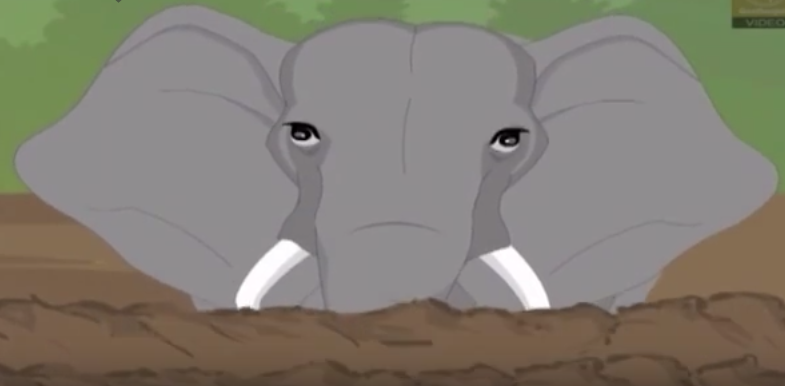
There was an elephant named Karpurathilaka in the forest of Brahmaranya. On seeing him, all the jackals said to themselves, 'If we can find out some way of killing him, we shall have plenty of food for four months.' Then an old jackal said, ' I can bring about his death by the power of my intellect.' He then went to Karpurathilaka and prostrating
before him said, 'Sire, grant me an audience.' The elephant asked, 'Who are you? Where do you come from.?' He replied, 'I am a jackal sent by the assembled beasts of the forest with this message for you. "Since it is not fit for us to live without a King, your majesty has been selected for being crowned as King of this forest in consideration of your kingly qualities- He who is pure in family, nobility and conduct, is chivalrous, pious and versed in politics, is fit to be a King. One should first obtain a King, then a wife, and then wealth. If there is no King, what is the use of having a wife-or wealth since they will be robbed away in no time? Like rain, the King is the support of all creatures, with this difference that life can be sustained even during a drought but never when there is no King. 

In this world, people keep within the bounds of righteousness mostly through dread of the King's punishment . A man who is naturally virtuous is difficult to find. It is only through fear of punishment that women are faithful to their old, deformed, sickly and penniless husbands. You are an ideal King. So we are all waiting to crown you."Sire, therefore come with me quick so that the auspicious moment(Hindus are very particular that the auspicious moments fixed by priests and astrologers are never transgressed) may not be passed.' Karpurathilaka was moved by the greed of a kingdom and followed the jackal and
ran before him lightly. The jackal passed over a concealed quagmire by skirting a firm edge of it. The deluded elephant however went straight into the quagmire and got stuck waist-deep into it. He called out 'Friend jackal, what am I to do now ? I have got stuck in this quagmire. I shall perish miserably. Turn back and look at me.' The jackal looked back with a smile and said ironically, 'Catch hold of my tail and get up. Since you were fool enough to place confidence in the words of one like me, suffer this unavoidable misery. It is said that those who delight int the company of the good will prosper and that these who consort with wicked persons will come to grief.' The elephant died in the quagmire, and the jackals ate his body for many a day. 

The Panchatantra - Story 68

STORY NO. 68. THE FOOLISH HUSBAND


Tungabala was the governor of the city of Virapura in the kingdom of Kanauj. Handsome and young and fabulously wealthy, he saw one day, when walking along the streets of the
city, the beautiful Lavanyavati, the wife of a young merchant named Charudatta. He was at once possessed with a violent desire for her and sent a woman skilled in such matters to her with a view to get her to meet him secretly. It has been said that a man keeps to the path of virtue, curbs his senses, has a sense of shame, and clings to modesty only so long as a beautiful and charming woman has not cast her piercing glances of love at him. For Lavanyavati too had fallen in love with him as soon as she saw him, and her looks had clearly betrayed her feelings. 

To the broachings of the messenger, Lavanyavati said, 'I am devoted to my husband. How can I be faithless to him without his consent ? A wife should be diligent in the management of the household, give birth to numerous children, love her husband as her own life, and obey his every behest- She ig unworthy to be called a wife who does not please her husband. If the husband is pleased with her, all the gods too are pleased with her. So, I shall unhesitatingly do whatever my husband orders me to but shall do nothing without his orders.' The messenger asked ' Do you really mean it, and will you act up to what you say?' Lavanyavati replied, 'Certainly.' Then the messenger returned to Tungabala and told him everything. He said, 'How is it possible to induce her husband to bring her here and offer her to me?' The go-between said, 'Seemingly impossible things, which can never be accomplished by valour, can easily be accomplished by a cunning device. An elephant was killed by a jackal by being entrapped in a quagmire. The governor asked her to relate the story. Then she related the story of "The Jackal And The Elephant".

The governor said to the go-between, 'Find out some device by which I can make this
merchant bring his wife and offer her to me.' She suggested a device, and he acted upon it He engaged Charudatta as an officer under him and employed him in the most confidential affairs. One day, he bathed and put on fine clothes and costly ornaments and said Charudatta, 'From to-night I have to observe a vow in honour of Gowri(Parvati, the consort of Siva, Her worship as Sakti is usually done by worshipping a young female in absolute privacy) for a month. Bring me therefore every night a young woman of good family. 

I shall have to worship her in due form.' Charudatta took that night a young damsel of good family and watched through the key-hole of the locked room what the governor did with her. Tungabala knew that he would be watching. So, he worshiped the young lady from a distance without touching her and gave her costly clothes, ornaments and unguents and sent her away with a guard. Charudatta's avarice was roused at this great reward. He was also deluded by the exemplarily decent treatment of the young lady by Tungabala. Desirous of securing such presents for his own wife, he took Lavanyavati for the next night without telling the governor who she was. Then he watched through the key-hole as before. Tungabala recognised Lavayavati from the very outset. As soon as the door had been securely locked, he fervently embraced her and consorted with her. Seeing this, Charudatta, not knowing what to do, stood like a figure drawn in painting, plunged in great sorrow, but impotent to do anything. 


The Panchatantra - Story 67

STORY NO. 67. ANOTHER'S DUTY IS DANGEROUS 


Karpurapataka was a washer-man in the holy city of Varanasi(Benares). One night, he
spent the major part of the time in love prattle with his newly-married young wife and slept soundly afterwards, being thoroughly exhausted. In his courtyard were tied his donkey and his dog who was sitting on its haunches watching. A thief entered the court- yard. The ass said to the dog, 'Friend, why don't you bark aloud and rouse our master as you are bound by your duty to do?' The dog replied, 'Don't meddle with my work or tell me what my duty is. You know that I used to guard his house faithfully day and night, since he has been happy and free from care of a long time, he does not realize my value to him and does not give me enough to eat. Unless there is some
danger, masters care but little for their servants. Let the thief steal some articles today. From tomorrow our master will feed me better.' 

The donkey replied, 'Hear me, you wretch. What servant is he and what friend is he who thinks of his reward at a time when his duty is action?' The dog replied, 'What master is he who starves his servants and talks merely sweet words to them in times of need ?' The donkey said in a rage, 'O, wicked wretch, you are surely a debased villain
since you neglect our master's interests at this critical time. Well, I must then do what I can and wake up our master. One should warm one's back in the sun, one's front before the fire, one should serve a master with all his heart, and strive for the next world with a pure soul/ Saying this, the donkey brayed aloud. The thief ran away, and the washer-man, coming out and finding nobody, took a big stick and belabored the donkey mercilessly, angry at his sleep having been unnecessarily disturbed. 

The Panchatantra - Story 66a

STORY NO. 66a. JARADGAYA AND DIRGHAKARNA


In the hollow of a big tree in Gridhrakuta hill on the banks of the Ganges, there lived a vulture called Jaradgava with his eyes and talons gone by an adverse fate. Out of pity for his plight, the birds living in that tree used to give him small portions from their food. He lived on them and in return watched the young birds while their parents were away in search of food. Once when the parent birds were away, a cat called Dirghakarna came to the tree to eat the young ones of the birds. Seeing him coming, they were terror stricken and raised a cry, Dirghakarna, seeing the vulture rush up said to himself, 'Alas, all is over with me. Still a danger should be dreaded only so long as it has not happened. When it has come, one should do his best to get out of it I am now in his presence and cannot escape by running away. So let what is destined to happen occur. I shall first create confidence in him and then approach him.' So he went to him and said, 'Sir, please accept my salutations.' The vulture asked, 'Who are you ?' He replied, 'I am a cat.' The vulture said,
'Get away; else, I shall be obliged to kill you.' The cat said, 'First, hear me, and then, if you consider me worthy of death do as you like. 

Is anyone honoured or killed merely because he happens to belong to a certain caste or tribe ? It is only after fully ascertaining one's conduct that we can know if he deserves to be honoured or killed.' The vulture said, 'Why have you come here ?' The cat replied, I live here on the banks of the sacred Ganges, bathing everyday, leading a life of celibacy and observing the Chandrayana(A fast of a severe type with graded meals) fast. Trustworthy birds told me that you were devoted to the study of the religious law books. So I came here to hear the holy law correctly expounded by you who are advanced in years and knowledge. Now I find that you are so ignorant- of it that you want to kill me, your guest. The sacred laws say, "Fitting hospitality should be shown even to a foe coming to one's house. The tree does not withdraw its shade from the cutter. Even if a man has not got wealth to entertain a guest he should entertain him with kind words at least. A grass mat, a place to sit in, water for washing the feet, and kind words are never absent for a guest in a good man's house. The good show kindness even towards creatures devoid of merit. The moon does not withhold his rays even from the out caste's hut. Fire is honoured by the Brahmins, the Brahmins by the four castes, the husband by a wife, and the guest by all men.

A guest turned back takes away all the accrued merit of the householder who has turned him back. Even a low caste guest should be duly honoured when he comes to the house of a high caste man, for every guest represents- all the gods."The vulture said, 'The cat is fond of flesh, and the young unfledged birds live here. So it is that I told you like that.' The cat thereupon touched the ground and his ears and said, 'I have learnt the sacred laws, am free from passion, and am undergoing the arduous Chandrayana fast. Though the sacred laws differ regarding many things, they are absolutely unanimous on abstinence from inflicting injury being the highest duty of a man. The reason is dear. Those who abstain from inflicting any injury, who forgive every injury to themselves and who give
refuge to all go to heaven. Only one's secured merit follows one after death as a friend. All else is destroyed with the body. When one eats the flesh of another, note the disproportion' between the evil done and the good secured. The eater enjoys but momentary pleasure of the palate. The eaten loses its very life. The agony that a creature suffers at the thought of approaching death cannot be imagined or described by another. Which sane person will commit deadly sin by killing animals for eating when he can easily fill this accursed belly with herbs growing by themselves in the forest?' 

The vulture was taken in by these words and allowed the cat to live in the hollow of the tree without telling the birds. Every day the cat swooped on some young bird or other stealthily, took it to the hollow and gobbled it up. After some days the sad parent birds whose young ones had been eaten up held a vigorous inquiry to trace the murderer. On seeing this, the cat quietly slipped out of the hollow and ran away. The birds made a close search all over the place, discovered the bones of their young ones in the hollow of the tree, came to the unanimous conclusion that the vulture had eaten their young ones, and killed him. 

The Panchatantra - Story 66

STORY NO. 66. SAVED BY A CROW


In the forest of Champakavati in Magadha lived a crow and a deer who had been intimate friends for long. The deer was plump and sleek. When once roaming about at will in the forest, he was seen by a jackal who said to himself, 'How can I taste his delicious flesh? The only way is to make him trust me.' So he went up to him and said, 'Friend, are you keeping good health ?' The deer asked, 'Who are you ?' The jackal said, 'I am the jackal
Kshudrabuddhi. I drag on a maimed existence here, having lost all my relatives. Now that we have met and become friends I can once more love a full life. I want to be your constant attendant.' The deer said, 'All right.' They wandered together till sunset. Then they both went to the abode of the deer. 

The crow Subuddhi, the old friend of the deer, was sitting on the branch of a champak tree. Seeing the deer come with a jackal, he asked him, 'Friend, who is this other?'. The deer said, 'This is a jackal who desires our friendship.' The crow said, 'Friend, sudden friendship with a stranger is not advisable. Shelter should not be given to anyone whose family and nature are not known. For the fault of a cat, the vulture Jaradgava Suffered death.' 'How so?' asked the deer and the jackal. Then the crow related the story of "Jaradgava and Dirghakarna". 

'So it is that I say' continued the crow 'that shelter should not be given to one whose family and nature are not known.' The jackal said angrily, 'The day when the deer met you
first you too were one with family and nature unknown. How is it then that he is becoming more and more intimate with you every day? Your little wisdom shines only here. Where there are no learned men, even a man of feeble intellect is lauded. In a treeless tract even a castor plant is regarded as a tree. 'This is mine, this is a stranger', these are thoughts indulged in only by the mean and narrow-minded. To the large-hearted the whole world is their family. Just as this deer has become my friend, so have you too.' The deer said, 'Why all this use- less wrangling? Let us all live happily together and have friendly discussions. For, nobody is born as another's friend or foe. It is only by intercourse that people become friends or foes.' The crow said, 'All right.' From that day the three lived together but wandered about separately during daytime in search of food. 

One day, the jackal said to the deer when they were alone, 'Friend, in a corner of this forest there is a field full of standing paddy. I shall take you there and show it to you.' Then he took the deer there. Every day thereafter the deer used to go to the field and eat the paddy. The owner of the field saw this and set a snare for it. When he went there again as usual, the deer was caught in the snare. Then he said to himself, 'Who but a friend can deliver me from this death-trap ?' Presently the jackal came along and, seeing the deer ensnared, said to himself - 'My desire has been accomplished by this clever device of mine. The farmer will surely cut him up here and leave the bones with the adherent flesh and blood. There will be ample food for me for some time.' 

The deer was delighted at the sight of his friend and said, 'Friend, snap my bonds at once with your teeth and set me free. The worth of a friend is to be tested in times of
calamity, of a warrior in battle, of an honest man when overwhelmed with debt, of a wife when all the money is gone, and of relatives in times of grief. He alone is worthy to be called a relative or friend who stands by one in festivities and mourning, in famine and anarchy, at the King's gate and on the cremation ground.' The jackal looked again and again at the net and said to himself with satisfaction, 'Ah,, this net is very strong and this deer cannot possibly escape from it himself.' Then he said to the deer, 'Friend, this snare is made with sinews. How can I touch these unclean things of animal matter with my teeth on this Sunday, the most sacred of all days, being dedicated to the Sun, the source of all light and purity? So please do not misunderstand me for my inability to comply with your wish to-day. Tomorrow morning I shall come and do whatever you ask me to do.' Then he went and concealed himself in an adjoining bush waiting for the farmer to come and lit up the deer and leave the coveted bones. 

The crow, seeing that the deer did not return in the evening as usual, searched for him everywhere and found him at dusk in the snare in the field. He asked, 'Friend, what is this?' The deer said, 'This is the result of my having disregarded your wholesome advice. Adversity overtakes him who listens not to the wise words of well-meaning friends. Such a man is the delight of his enemies. The crow asked, 'Where is that traitor ?' The deer said, 'Hankering after my flesh he is hiding in yonder bush.' The crow said, 'I had already warned you. Simply because we are innocent and blameless it is no reason for trusting a wicked man, for even the virtuous come causelessly to grief at the hands of the wicked. Those whose death has knelled perceive not the smell of an extinguished lamp(That is, do not know when their lease of life has run out by a senseless act like the deer's befriending the jackal), listen not to the wise words of a friend and have not keenness enough to see the tiny star Arundhathi(The meaning is that only the very keen can perceive this tiny star or danger looming very small in the horizon like this star). 

A friend who speaks sweetly in one's presence and frustrates one's object in his absence is to be shunned like a pot of poison with milk on the surface.' The crow then heaved a deep sigh and said, 'O villain, why have you done such a wicked act? What credit is there in deceiving friends who are made to be associated with you and to entertain hopes from you by your delusively sweet words and hypocritical attentions ? Oh, goddess earth, how can you bear the burden of a wicked wretch who, violating his promise, practices evil upon a benevolent, unsuspecting, simple-hearted soul? One should not love or form a friendship with a wicked person who like a charcoal burns when hot and soils the hand when cold. But why do I complain of the conduct of the jackal, seeing that this is the settled course of conduct of the wicked ? First, the wicked man falls at our feet, then sings some sweet and wonderful humming song into our ears, and finally ends by biting us. 

A gnat and a wicked man are quite alike in this. That a wicked man speaks sweetly is no
reason at all for trusting in him, From his tongue flows honey, but in his heart of hearts is the deadliest of poison, Oh, friend deer, the farmer will come at dawn and I am unable to snap your bonds. So' when I see him from afar 1 shall warn you. You lie down flat and pretend to be dead. When I caw again get up and run quickly.' At dawn, the farmer came with a stick in his hand. Seeing him come from a far, the crow warned the deer who lay down flat and pretended to be dead. Seeing hint lying thus in the net, the farmer said with joy, 'Ha ! You died by yourself, did you?' and removed him from the net. When he was folding his net the crow cawed and the deer got up and ran in headlong flight and soon passed the bush where the jackal was hiding. The chagrined farmer flung his stick at him with all his might. It hit the jackal and felled him dead. 

The Panchatantra - Story 65

STORY NO. 65. THE TRAVELLER AND THE BRACELET


In a southern forest there was an old tiger. One day, he bathed and sat on the banks of a lake with kusa(A long grass used for making ropes. It is sacred to the Hindus and is used by them on ceremonial occasions) grass in one hand and a gold bracelet in the other and cried out to all the passers-by, 'Oh, ye travellers, here, take this gold bracelet as a gift.' All passed by without responding to the offer. At last, there came a traveller whose greed was roused and he said to himself, 'I am lucky to have this offer made to me. But I should proceed cautiously since there is some risk. Even a desired object when got from an undesirable source, leads to evil just as even nectar, if contaminated by poison, will bring about death But every attempt to obtain wealth is attended with risk.

Without risking something, nobody will grow wealthy. He who risks something and survives
will become wealthy. I shall scrutinize this offer further. He then asked the tiger » ^Where is the bracelet ?' The tiger stretched forth his paw and showed it. The traveller said, 'How am I to trust such a ferocious creature like you?' The tiger replied, 'Oh, traveller, listen to my tale and be convinced. In my youth I was extremely wicked. Owing to my slaughtering many men and cows, my wife and sons perished, leaving me as the sole survivor. I was then advised by a holy man to give charity and do such holy acts. Acting on his advice, I am now bathing daily and giving gifts. I am old and have lost my teeth and the power of ray claws. Why should you then mistrust me? Sacrifice, study of the Vedas, charity, penance, truthfulness, patience, forgiveness and absence of greed, this is the eight-fold path of righteousness laid down in our scriptures. Of these, the first four may be practiced for mere display, but the last four can only be found in a great soul. I am so far free from greed that I wish to give away to anybody who will have it this valuable gold bracelet which is in my hand. But it is difficult to dispel the slander of the world that a tiger will eat a man whenever it gets a chance.

Blindly following one another, people do not regard a preaching bawd as an authority in religious matters though they recognize even a Brahmin who has killed a cow to be such an authority. I have studied all the sacred laws. A gift to a poor man is as fruitful as rain in a desert or food given to a hungry man. Everybody loves his life just as dearly as we do. The good regard all creatures with kindness comparing them unto themselves. A man will know what to refuse and what to give, what is pleasure and what is pain, and what is agreeable and what is disagreeable, by applying the test to himself. He alone is a wise man who looks upon another's wife as a mother, another's wealth as a lump of earth, and all creatures as equal unto himself. You are very poor. I want to give you this valuable bracelet. Wealth should be showered on the poor and not on the rich. Medicine is for him who is sick. Of what use is it to a healthy man ? The sages consider that to be the best of gifts which is given purely for the sake of charity, without expectation of return, at the proper time and place to one who has not done anything in return and who is a proper recipient. So, bathe in the lake and accept this bracelet.' 

The traveller believed the tiger's words and, moved by greed for the bracelet, entered the lake for bathing. No sooner had he entered it than he got stuck waist-deep in the mire and was unable to run away. The tiger, seeing him stuck in the quagmire, said 'Alas, you have got stuck in the quagmire- I shall pull you out.' Saying this, he approached him
slowly. Seeing him approach, the traveller said to himself, 'A villain is not to be trusted simply because he reads the sacred law books or studies the Vedas. It is the innate nature of a person that matters in the last resort just as cow's milk is sweet whatever the now eats. The actions of those whose senses and mind are not under control are as unreliable and worthless as the bath of an elephant(An elephant covers itself with dust immediately after a bath).' Mere preaching without practice is so much heavy lumber like ornaments bestowed on an ugly woman. 

I committed a folly in trusting this ferocious beast. One should never trust rivers, armed men, clawed and horned animals, women, and Kings. It is innate nature that has to be looked into, for it prevails in the end. Even the mighty moon, the wanderer of the sky, the destroyer of darkness and sin, the thousand-rayed one marching in the midst of stars, is devoured by Rahu(The reference is to the eclipse- In Hindu mythology, the eclipses are brought about by the demon Rahu trying to swallow the sun and the moon) by Fate's decree. Who can go against what is written on his forehead by Fate ?' When he was thinking in this strain, he was killed and eaten by the tiger.